

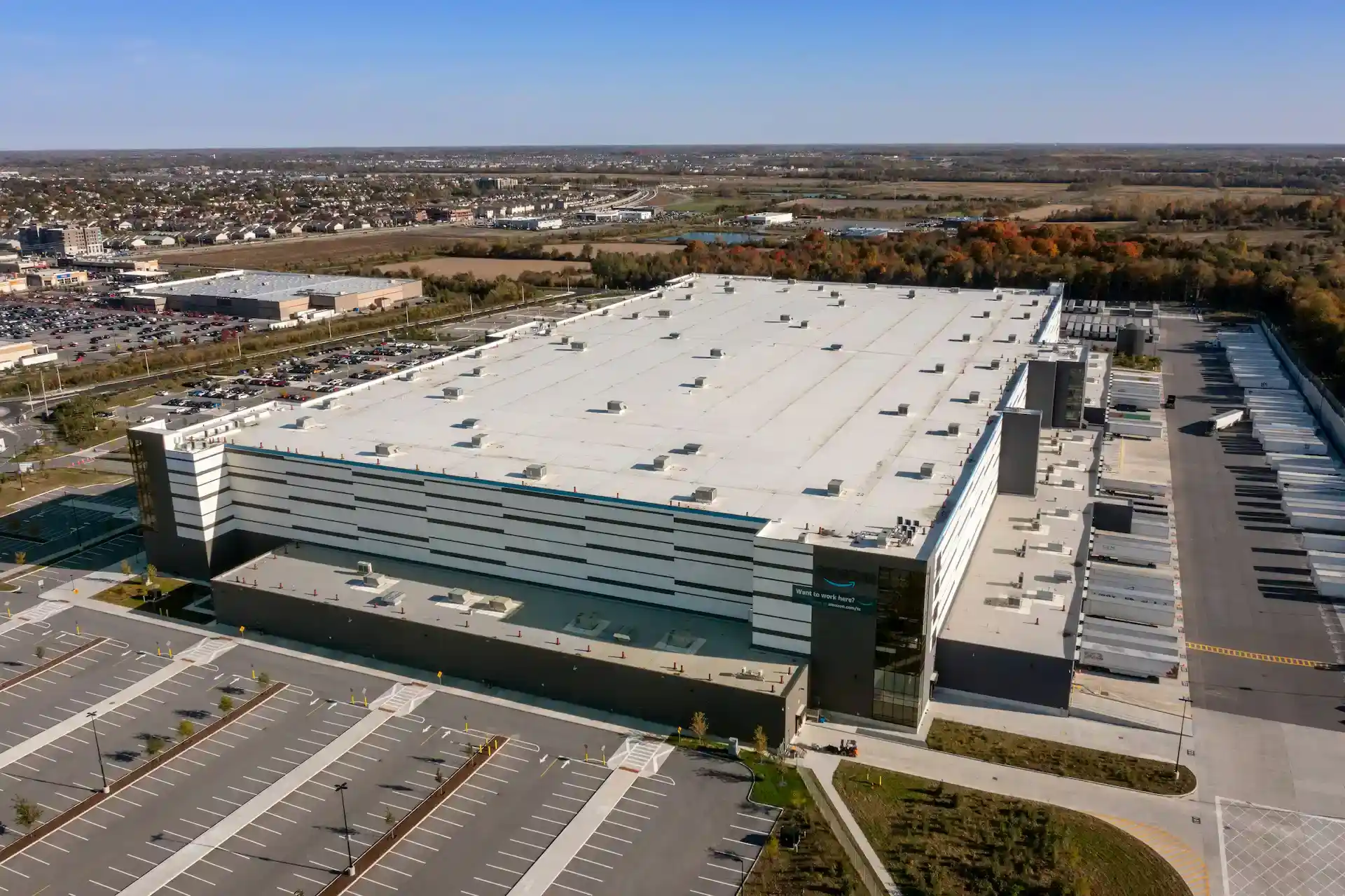
Warehouse and Distribution Center Roofing roof planning built from the roof condition.
Warehouse and Distribution Center Roofing starts with understanding where the roof is failing, how the building is used, and what level of disruption the property can support.
The review connects leak history, membrane condition, flashing details, drains, penetrations, access, and schedule constraints into a practical roof path.
Commercial Roofing Contractors of Boston keeps the next step clear for Boston, MA commercial buildings that need repair, replacement, coating, or maintenance decisions.
Commercial roof scope, documentation, access planning, and weather-aware scheduling for acrylic roof coatings.
The Amazon Fulfillment Center in Fall River, which serves the Greater Boston distribution network, and the FedEx Ground hub in Wilmington off Route 125 together illustrate the dense industrial logistics infrastructure that rings Boston and drives demand for specialized warehouse roofing expertise across eastern Massachusetts. Owners and property managers operating large distribution and storage buildings throughout Suffolk, Middlesex, and Norfolk counties face a roofing environment shaped by aggressive four-season weather, century-old code traditions, and a construction labor market that commands some of the highest wage rates in the country.
Drainage engineering takes on extra urgency in the Boston market because the region averages over 47 inches of precipitation per year and receives significant snowfall, with winters producing multiple cycles of snow accumulation, melt, and refreeze. Flat-roof drainage systems on large warehouse footprints must be designed not just for rainfall intensity but for the additional load of saturated snow and the risk of ice dam formation at drain sumps. Primary drains in low-slope Bostonian warehouses are typically installed with electric heat-trace cables inside the leader pipe and at the drain bowl to prevent freeze blockage during January cold snaps that drive temperatures to single digits.
TPO membranes dominate new warehouse roofing installations in the Boston metro because of their weldable seam technology, which provides a stronger bond than adhesive laps under the freeze-thaw stress cycling that eastern Massachusetts roofs endure year after year. A fully adhered 60-mil TPO installation over polyisocyanurate insulation is the standard specification for Class A distribution buildings, while mechanically attached systems are common on lower-budget industrial buildings where wind uplift calculations still allow it. Massachusetts's energy code, aligned with the IECC commercial provisions, requires minimum R-values for continuous insulation that drive iso board thickness to three or four inches on most new-construction and reroofing projects.
Dock door and truck court flashing on Boston-area warehouses faces a specific challenge that warmer-climate facilities do not: freeze-thaw cycling at metal wall-to-roof transitions. The repeated expansion and contraction of metal dock door frames and exterior wall panels works silicate-based caulks and rigid flashings loose over three to five years, creating the entry points for water infiltration that then freezes behind interior wall finishes. Experienced Boston warehouse roofers specify EPDM-based flexible flashing tape at these transitions rather than sheet metal alone, providing an elastic bridge that accommodates movement without cracking.
Rooftop exhaust equipment on Boston warehouse facilities frequently includes propane and electric forklift battery-charging ventilation, cold-storage refrigeration condensing units, and the rooftop-mounted mechanical smoke exhaust fans required by Massachusetts State Building Code for large-area warehouses. Each curb penetration requires a minimum eight-inch height above the finished membrane, factory-fabricated curb caps properly integrated with the single-ply field membrane, and pitch pockets or pre-molded boots where round conduit penetrations cannot be accommodated by a standard curb. Coordinating the installation sequence of new membrane sections around active refrigeration equipment is a standard project management challenge that Boston roofing contractors handle through phased work plans reviewed with the facility operations team.
Snow load management is a non-negotiable design discipline for any warehouse roof in Greater Boston. The Massachusetts State Building Code sets a ground snow load of 40 psf for the Boston basin, with drift factors at parapet walls and equipment screens adding significant point loads beyond the design uniform value. Before any reroofing project, the roofing contractor should provide the owner with a letter from a licensed Massachusetts structural engineer confirming that the proposed new assembly—membrane, insulation, fasteners, and ballast if applicable—does not exceed the roof's structural capacity. Several large-format industrial buildings in the Everett and Chelsea industrial corridors were built to minimum 1970s-era structural standards and may require deck reinforcement before a full insulation upgrade is feasible.
Energy efficiency is a major driver of roofing specification choices in Boston because the city's heating-dominated climate means that insulation R-value pays back far faster than reflective membranes do compared to Sun Belt markets. A Boston warehouse operator upgrading from a 1990s-era built-up roof with R-11 insulation to a modern TPO-over-polyiso assembly at R-30 can expect meaningful reductions in gas heating bills through improved thermal resistance of the roof plane, which is the largest single surface area in the thermal envelope of a single-story building. For refrigerated or frozen-storage distribution facilities, vapor retarder placement beneath the insulation is mandatory to prevent moisture from migrating into the insulation and reducing its effective R-value over time.
Cost per square foot for warehouse roof replacement in the Boston metro ranges from $10.00 to $15.00 installed, reflecting the region's high union labor rates, lengthy permit timelines through Boston ISD or suburban building departments, and the cost of winter weather protection if work extends into cold months. Large-footprint projects over 150,000 square feet benefit from scale efficiencies in material delivery and crew productivity, but the labor cost floor in Massachusetts limits how far unit costs compress even on very large jobs. Owners should obtain at least three bids from contractors who carry the NRCA-endorsed manufacturer certifications required to issue NDL (No Dollar Limit) warranties on large industrial roofs.
Roof asset management for Boston-area warehouse operators should account for the Massachusetts Department of Fire Services requirements for roof access and smoke vent maintenance, which add an inspection obligation beyond the standard warranty inspections. A well-maintained roof management program for a major Boston-area distribution center includes semi-annual inspections tied to warranty requirements, annual infrared moisture scans to detect wet insulation before it triggers deck rot, and a capital planning reserve that allocates funds for partial re-roofing of sections identified as failing before they propagate moisture damage into adjacent areas.
- EPDM Commercial Roofing
- Standing Seam Metal Roofing
- Emergency Tarp Dry
- School Roofing
- Government Building Roofing
- KEE Single Ply Roofing
- Snow Ice Flat Roof Repair
- Multifamily Roofing