

Solar Roof Integration for Boston, MA Commercial Buildings roof planning built from the roof condition.
Solar Roof Integration for Boston, MA Commercial Buildings starts with understanding where the roof is failing, how the building is used, and what level of disruption the property can support.
The review connects leak history, membrane condition, flashing details, drains, penetrations, access, and schedule constraints into a practical roof path.
Commercial Roofing Contractors of Boston keeps the next step clear for Boston, MA commercial buildings that need repair, replacement, coating, or maintenance decisions.
Where the Roof Meets the Array on Boston Commercial Buildings
A rooftop solar array lives for twenty-five years or more. The membrane underneath it usually does not. That mismatch is the single fact we keep front and center on every photovoltaic project we touch across Boston, because getting the order of operations wrong is what turns a smart energy investment into an expensive teardown five years early. We are roofers first, and our job on a solar project is to make sure the surface carrying those panels is sound, watertight, and warranted before a single rail goes down.
We see this work across the full spread of the city's commercial stock. Life-sciences and lab buildings out along the I-95 belt through Waltham and Lexington have flat, equipment-heavy roofs that owners increasingly want to put to work generating power. The big-floorplate distribution and last-mile warehouses near the Widett Circle and Newmarket industrial pockets south of downtown offer acres of uninterrupted low-slope membrane that is ideal for ballasted racking. Older masonry mill buildings in Charlestown and the Fort Point Channel district carry rooftops that were never designed for added dead load, and those buildings need a structural conversation before anyone talks panel count.
The Membrane Has to Outlive the Panels
Before we will sign off on a solar layout, we pull the existing roof apart on paper. How old is the membrane? What is the documented remaining service life? Are there wet areas, failed seams, or thin spots that a moisture survey would flag? If a roof has fifteen or more good years left, mounting an array on it is reasonable. If it has seven or fewer, we tell owners plainly that the better money move is to recover or replace the roof first and set the panels on a fresh surface. Removing and re-setting an array so a worn-out roof can be torn off underneath it can add tens of thousands of dollars to a future reroof, and we would rather an owner hear that now than discover it later.
When the timing lines up, we like to pair the reroof and the solar mount as a single coordinated scope. A new white reflective membrane goes down, gets inspected, gets its warranty paperwork started, and only then does the racking arrive. That sequence protects everyone and gives the building a roof and a power plant that age on the same clock.
Penetrations: The Detail That Decides Everything
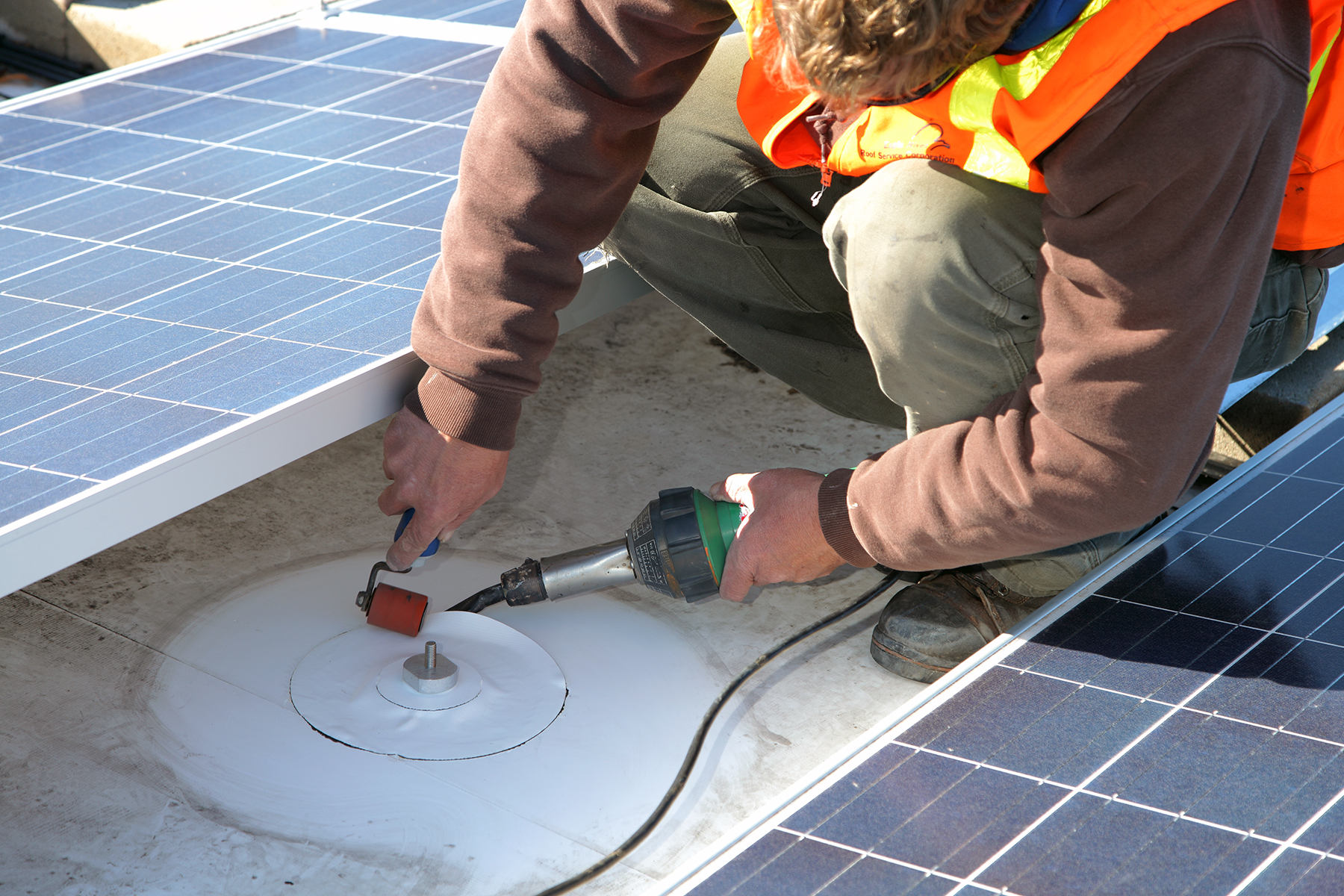
Every place a fastener or a conduit passes through the membrane is a place water wants to get in. On low-slope Boston roofs we lean heavily toward ballasted racking systems, which hold the array in position with weighted pavers or concrete blocks and avoid puncturing the membrane at all. When the roof slope, the wind exposure, or the structure rules out ballast, we move to mechanically attached racking, and then each attachment foot becomes a flashed roof penetration detailed to the membrane manufacturer's specification. We do not let the solar crew improvise those details. The roofer flashes the penetrations, period, because a generic pipe boot slapped over a racking foot is a leak waiting to happen.
Conduit is the quietly dangerous part. The electrical runs carrying DC power from the array down to the building's service have to cross the roof, and if that conduit is laid directly on the membrane it abrades the surface every time the metal expands and contracts in the sun. We set conduit on approved standoffs, we route it deliberately, and we flash the through-roof penetration with a proper detail rather than a caulked boot. None of that happens correctly unless the roofer and the solar electrician sit down before the work starts and agree on routing and penetration locations.
Weight, Wind, and What the Structure Can Carry
Two loads matter on a rooftop array, and Boston's weather makes both of them sharper. The first is dead weight. Ballasted systems concentrate the mass of pavers across the membrane, and that added pounds-per-square-foot has to be checked against the original structural capacity of the deck and framing. Many of the city's older buildings were designed with thin margins, and a winter snow load stacked on top of solar ballast is exactly the combination that finds a weak roof structure. We coordinate with a structural engineer whenever the numbers are close.
The second load is uplift. Boston catches coastal wind off the harbor and the periodic nor'easter that drives sustained gusts across exposed rooftops, and a field of solar panels is essentially a field of small wings. Racking has to be ballasted or anchored to resist that uplift, and the perimeter and corner zones of the roof, where wind pressure is highest, often need extra weight or tie-downs. We design the array layout with those wind zones in mind rather than treating the whole roof as one uniform field.
Coordinating the Roof Warranty and the Solar Warranty
This is where projects fall apart when nobody owns the seam between the two trades. The membrane manufacturer has requirements for what can sit on a warranted roof: approved ballast pads, approved walkway protection, approved penetration details, and in most cases a pre-installation review by the manufacturer's field representative. The solar installer has separate warranties on the modules, the inverters, and the racking. If those two sets of requirements are not reconciled before installation, the owner can end up with a solar array that quietly voids the roof warranty, leaving any future leak repair on their own dime.
We run the manufacturer warranty review as part of the project, document the approved details, and make sure both the roofing and the solar systems get registered correctly. Our role is not to sell anyone a solar system. It is to make sure the roof under that system is right, the penetrations are watertight, the loads are accounted for, and the paperwork holds up. A great solar contractor mounting panels on a roof that was never prepared is still a problem we get called to fix, and we would rather prevent that call than answer it.
How We Work With Your Solar Provider
- We assess the existing membrane and give an honest remaining-service-life estimate before any array is designed.
- We recommend reroof-first or solar-on-existing based on that estimate, with the cost of a future array removal spelled out.
- We hold a pre-construction meeting with the solar EPC to lock down racking type, conduit routing, and penetration details.
- We flash every penetration to the membrane manufacturer's specification and keep that work under the roof warranty.
- We coordinate the manufacturer's warranty review so the finished installation is covered by both the roofing and solar warranties.
If you are weighing rooftop solar on a Boston commercial building, the smartest first call is to the roofer, not the panel salesman. Reach out and we will give you a clear read on whether your roof is ready to carry an array for the next twenty-five years.