

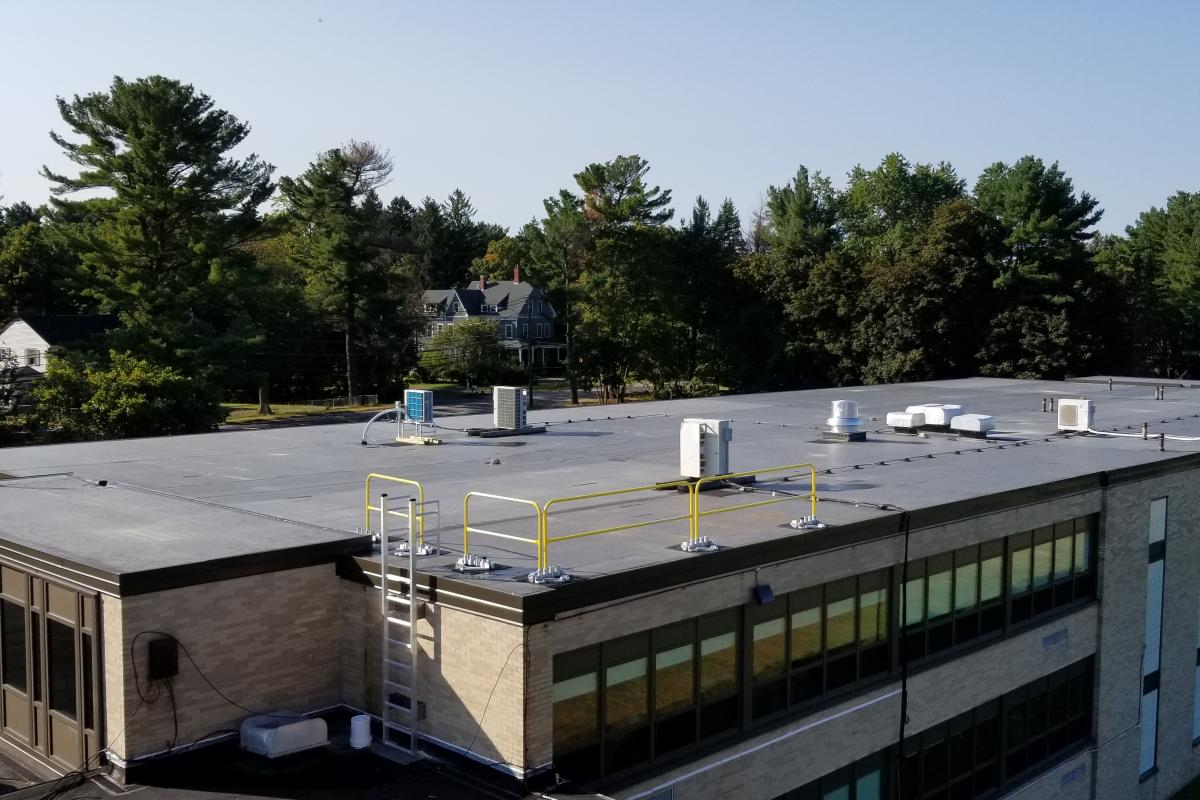
Government and Municipal Building Roofing roof planning built from the roof condition.
Government and Municipal Building Roofing starts with understanding where the roof is failing, how the building is used, and what level of disruption the property can support.
The review connects leak history, membrane condition, flashing details, drains, penetrations, access, and schedule constraints into a practical roof path.
Commercial Roofing Contractors of Boston keeps the next step clear for Boston, MA commercial buildings that need repair, replacement, coating, or maintenance decisions.
Commercial roof scope, documentation, access planning, and weather-aware scheduling for acrylic roof coatings.
Boston's inventory of municipally owned buildings reads like an architecture and civic history textbook — Faneuil Hall, the Old State House, neighborhood branch libraries built with Carnegie funding, fire houses dating to the early 1900s, and the sprawling Boston City Hall complex on Cambridge Street whose brutalist concrete roof deck has challenged maintenance crews for decades. Managing roofing on these structures demands contractors who can navigate Massachusetts public procurement law, coordinate with the Boston Landmarks Commission, and deliver systems that survive the full fury of nor'easters, freeze-thaw cycles, and summer humidity that characterize the coastal New England climate.
The City of Boston procures roofing services under Chapter 149 of the Massachusetts General Laws, the public building construction statute, which imposes distinct requirements based on project dollar thresholds. Work above the filed sub-bid threshold requires general contractors to publicly advertise for sub-bids from specialty trades including roofing, and roofing subcontractors must be prequalified for the work category. Projects above the general bid threshold must be publicly advertised for at least two weeks in the Central Register and the Procurement Bulletin. Our estimating team tracks the Boston Public Facilities Department bid calendar continuously and prepares compliant sub-bid filings that include all required statements of qualifications.
Massachusetts public construction law mandates prevailing wages set by the Department of Labor Standards under M.G.L. Chapter 149, Section 26. The wage schedule for Suffolk County covers roofing mechanics, roofer apprentices, and related classifications at rates that must be posted at the job site and incorporated verbatim into all sub-subcontractor agreements. The DLS audits certified payroll records submitted by contractors on public projects and can refer violations to the Attorney General's Office. We maintain dedicated payroll staff who prepare weekly certified payrolls, verify sub-tier compliance, and respond to DLS audit requests without disruption to field operations.
Boston's climate presents roofing challenges that are rare in most American cities. The combination of frequent freeze-thaw cycling — Boston averages roughly 100 freeze-thaw events annually — heavy snow loads that can exceed 40 psf on low-slope roofs in major storm years, and salt-laden air from Boston Harbor creates accelerated deterioration in exposed metal components. City facilities like fire stations in East Boston or public works yards in South Boston see membrane systems stressed by ponding caused by inadequate drainage and ice dam formation at parapet walls. We design tapered insulation plans into every re-roofing specification to eliminate ponding, and we select flashings and edge metals in stainless steel or coated aluminum to resist salt-driven corrosion.
A significant share of Boston's civic building stock is subject to jurisdiction by the Boston Landmarks Commission, the Massachusetts Historical Commission, or both. The BLC's review process requires a Certificate of Appropriateness before any exterior changes — including roofing material substitutions — on designated landmarks. For buildings like police station houses in Back Bay or branch libraries in Roxbury with historic designations, preserving original slate, clay tile, or ornamental copper requires specialized subcontractors and materials sourced from mills still producing compatible profiles. Our historic preservation crew holds documented experience working with the BLC submittal process and understands the difference between rehabilitation and replacement standards under the Secretary of the Interior's guidelines.
Insurance and bonding requirements on Boston public building projects reflect the complexity of working in a dense urban environment with occupied structures. The City of Boston typically requires commercial general liability limits of $5 million per occurrence on roofing contracts involving occupied buildings, along with umbrella coverage, workers' compensation, and installation floater coverage for materials stored on-site. Performance and payment bonds equal to 100% of the contract value are standard. Our bonding line and insurance program are structured specifically for public sector work, and our certificates of insurance name the City of Boston and the Boston Public Facilities Department as additional insureds as required by standard city contract language.
Energy efficiency improvements to rooftop systems have become a formal requirement rather than an optional upgrade in Boston's municipal construction. The Boston Green Building Ordinance applies to city-owned buildings above a certain square footage and requires compliance with ASHRAE 90.1 for roof assembly thermal performance. The City's Climate Action Plan further commits to deep carbon reductions across the municipal portfolio, meaning cool-roof solar reflectance requirements and high-R insulation upgrades are standard elements of any significant re-roofing scope. We work with the Boston Environment Department to document projected energy savings, which can support future appropriations for similar projects across the city's building portfolio.
Roofing on Boston's government buildings is ultimately a public trust. When the roof of a branch library in Dorchester leaks, it's the community that loses access to services while emergency repairs are made. When a fire station in Charlestown requires premature replacement due to a poorly executed original installation, taxpayers absorb the cost. Our commitment to Boston municipal clients goes beyond winning the bid — it extends through commissioning, warranty administration, and the kind of documented workmanship that holds up when the city's facilities staff reviews the record years later.
- Commercial Roof Inspection
- Roof Drains Scuppers
- Self Storage Roofing
- Commercial Reroofing
- Modified Bitumen Roofing
- Storm Damage Roof Repair
- Auto Dealership Roofing
- TPO Single Ply Roofing